Islamic prohibition on lighting candles for the dead
Grey BeesThe Islamic prohibition on lighting candles for the dead is presented through the mourning for Akhtem, when the imam explains that Muslims do not light candles for the deceased. The rule does not end the family’s candle-lighting: Aisha extinguishes the flame at the imam’s direction, and Aisylu relights it once he has gone. Later, Aisha tells Sergeyich that the imam scolded her mother and that the family hides the candle when he visits. The episode makes the rule a lived practice negotiated inside a grieving household, rather than an abstract statement of doctrine.
The Candle at Akhtem’s Mourning
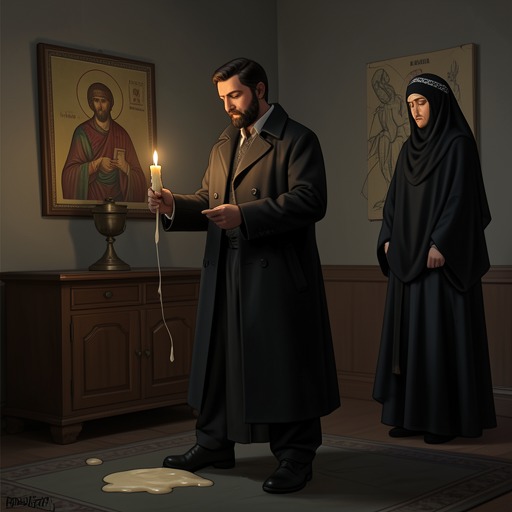
At the gathering after Akhtem’s funeral, the imam points to a burning candle and explains something to those present. Aisha responds immediately: she goes to the dresser and blows out its flame. The imam looks at her approvingly. His gesture and her action establish the prohibition in the scene without requiring Sergeyich, who does not understand the imam’s language, to translate the exchange for himself.
The candle’s brief extinguishing occurs amid a larger funeral observance. Akhtem’s body has been brought into the yard, and the imam has led prayers at his grave. The visitors at the burial are men, and Sergeyich experiences the procession and cemetery rites as an outsider to a language and custom he cannot fully understand. Against that distance, the candle scene offers a more legible encounter: he can see what the imam indicates, what Aisha does, and the approval that follows.
Instruction and Household Practice
The imam’s authority in the moment is made explicit by Aisha’s compliance and his approving glance. Yet the scene does not depict the candle as permanently removed. After the imam leaves, Aisylu gets up, goes to the dresser, strikes a match, relights it, and returns to the table. The sequence—extinguishing, approval, departure, relighting—shows a household moving between public religious instruction and its own continuing act of remembrance.
Aisha later explains the practice to Sergeyich. When he asks why the candle is lit, she says that Muslims do not light candles for the dead and that her mother hides it when the imam comes. Her account clarifies both the rule and the family’s response: the prohibition is known, the imam has reprimanded Aisylu for the candle, and the candle nevertheless returns when he is absent. The evidence does not state why Aisylu chooses to relight it, but the repeated act places remembrance alongside observance rather than making either disappear.
Forty Days and the Funeral Date
The rule is discussed within a defined period of mourning. Aisha says that the candle will be lit for forty days. Sergeyich asks how that count can be kept when Akhtem was killed long ago and the exact date of his death is unknown. Aisha answers that the count begins on the date of the funeral, as the imam told them.
Her answer connects the practice of mourning to a date the family can identify. The uncertainty surrounding Akhtem’s death does not prevent the forty-day observance from being reckoned: the funeral supplies its starting point. The same imam who objects to the candle has given Aisha the instruction about when the forty days begin, so his guidance shapes the family’s observance even where the candle practice remains contested.
Sergeyich as Witness
Sergeyich encounters the rule first as an observer and later as someone trying to understand it. At the gathering, he cannot understand the imam’s words, but watches Aisha extinguish the flame and sees the imam’s approval. In their later conversation, his questions move from the duration of candle-lighting to the timing of the forty days, and then to the reason for the prohibition. Aisha supplies the explanation directly.
The rule thus marks both a religious boundary and a point of contact across it. Sergeyich has already experienced Akhtem’s funeral as someone neither fully outside nor fully included in the community; the candle conversation gives him specific knowledge without erasing that difference. In the family’s alternating acts of extinguishing and relighting, the novel presents mourning as a practice shaped by religious instruction, household choice, and the uncertain circumstances of a death whose exact date remains unknown.